


Democratic Women’s Caucus and Congresswoman Alma Adams Statement on Black Women’s Equal Pay Day
Washington, DC,
August 3, 2021
CONTACT: Michelle Moreno-Silva
Today, Democratic Women’s Caucus (DWC) Co-Chairs Congresswomen Brenda Lawrence (MI-14), Jackie Speier (CA-14), and Lois Frankel (FL-21), and Vice Chairs Congresswomen Veronica Escobar (TX-16) and Sylvia Garcia (TX-29) along with DWC Member Congresswoman Alma Adams (NC-12) issued the following statement on Black Women’s Equal Pay Day.
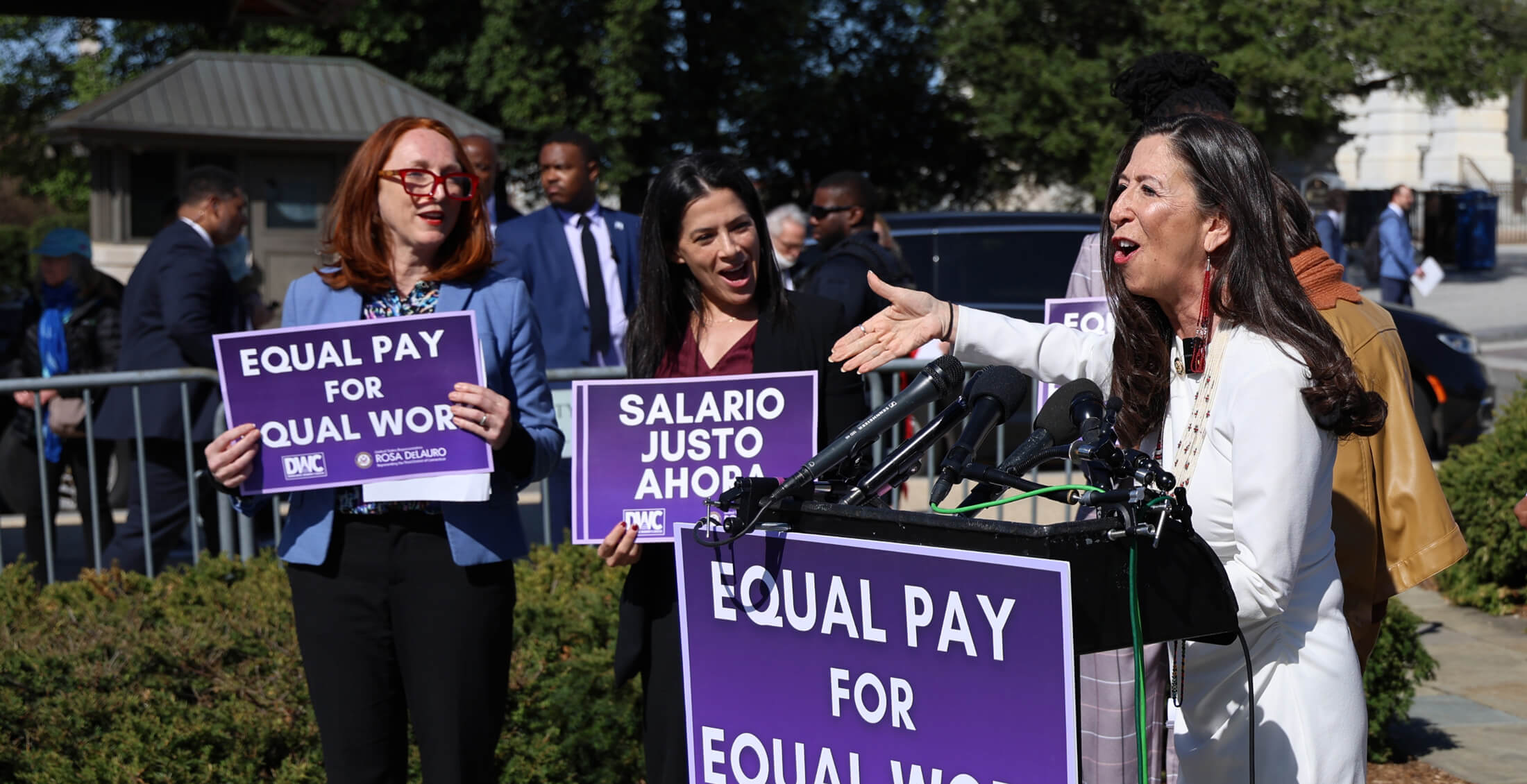
“One of the greatest economic injustices in our nation is the unequal pay Black women receive for equal work and the devaluation of Black women’s labor,” said DWC Leadership. “Decades of race and gender-based discriminatory employment practices have contributed to this pay gap that has forced Black women to work for nearly 20 months to earn what non-Hispanic white men make in just 12. Black women make up a significant portion of our care industry, work that our economy desperately relies on to keep moving, especially throughout the COVID-19 pandemic. It’s so important that we invest in the care economy to make sure that care workers, who are disproportionately women of color, are paid fairly for the critical role they play in helping our economy Build Back Better. We also call on Senate Republicans to stop their obstruction of H.R. 7, the Paycheck Fairness Act, which will help address unjust pay disparities for women and women of color.”
“Today is Black Women’s Equal Pay Day, which recognizes that many Black women have to work 19 months to make the same amount of money – for the same work – that an average white male makes in just 12 months’ time. That’s because Black women working full-time, year-round, are paid 63 cents for every dollar paid to White, non-Hispanic men,” said Congresswoman Adams. “Lower wages rob women of an equal life: the ability to pay for education, for health insurance, for food, and for housing. My family lived this struggle: my mother cleaned houses and saved up and pinched every penny so I could be the first person in my family to go to college. I can only imagine what she would have been able to accomplish had she been paid a fair wage. That is one of many reasons why I am proud to lead the Black Women’s Equal Pay Day Resolution in the House of Representatives, alongside my dear friend Reverend Warnock in the Senate.”
According to Census Bureau data, Black women working full-time are paid 63 cents for every dollar paid to White, non-Hispanic men. As a result of this discrepancy, Black Women’s Equal Pay Day—which marks the day that symbolizes how long into 2021 Black women must work to make what men were paid in 2020—does not occur until August 3, 2021. This disparity annually costs Black women $24,110 on average, equaling $964,400 over the course of a 40-year career.
H.R. 7, the Paycheck Fairness Act, would eliminate loopholes in the Equal Pay Act by requiring employers to prove that pay disparities exist because of legitimate, job-related reasons. The bill would also remove obstacles to participating in class action lawsuits, allow punitive damages, ban the practice of asking applicants their salary history or retaliating against coworkers who discuss their pay, among other changes. H.R. 7 passed the House of Representatives in a bipartisan vote on April 15, 2021, and was filibustered in the Senate.
Congresswoman Adams and DWC leadership introduced a resolution to mark Black Women's Equal Pay Day. This resolution was cosponsored by 72 members and endorsed by Women Employed, National Partnership for Women & Families, National Urban League, American Association of University Women (AAUW), MomsRising, The National Council of Negro Women, Inc. (NCNW), Center for American Progress, ERA Coalition, Equal Pay Today, Equal Rights Advocates, National Women’s Law Center, A Better Balance, United State of Women (USOW), Clearinghouse on Women's Issues, Feminist Majority Foundation, National Council of Jewish Women, Women’s Law Project, National Organization for Women, Methodist Federation for Social Action, Time’s Up Now, In Our Own Voice: National Black Women’s Reproductive Justice Agenda, NARAL Pro-Choice America, UltraViolet, The WAGE Project, Inc., chicago foundation for women (CFW), URGE: Unite for Reproductive & Gender Equity, Catholics for Choice, Workplace Fairness, National Employment Law Project (NELP), National Education Association, YWCA USA, Union for Reform Judaism, Economic Policy Institute, Ujima Inc.: The National Center on Violence Against Women in the Black Community (Ujima), AnitaB.org, Center for Advancement of Public Policy, Planned Parenthood Federation of America, Coalition of Labor Union Women, AFL-CIO (CLUW), Women of Reform Judaism, Feminist Women's Health Center, Futures Without Violence, Jewish Women International, Justice for Migrant Women, National Resource Center on Domestic Violence, Casa de Esperanza: National Latin@ Network, Shriver Center on Poverty Law, National Network to End Domestic Violence, Black Women’s Blueprint, Lovelace Consulting Services, Inc., National Asian Pacific American Women's Forum (NAPAWF), National Organization of Black Elected Legislative Women (NOBEL Women), Supermajority, AFL-CIO, Resilience, Eta Phi Beta Sorority, Incorporated (Affiliate of the National Council of Negro Women); Swing Phi Swing Social Fellowship, Inc. (Affiliate of the National Council of Negro Women), Legal Momentum, the Women's Legal Defense and Education Fund; Center for Law and Social Policy (CLASP), Oxfam America, National Birth Equity Collaborative, The Academy of Nutrition and Dietetics, Global Justice Center, National Coalition of 100 Black Women Inc. (NCBW), and Wage Equity Now.
###
|