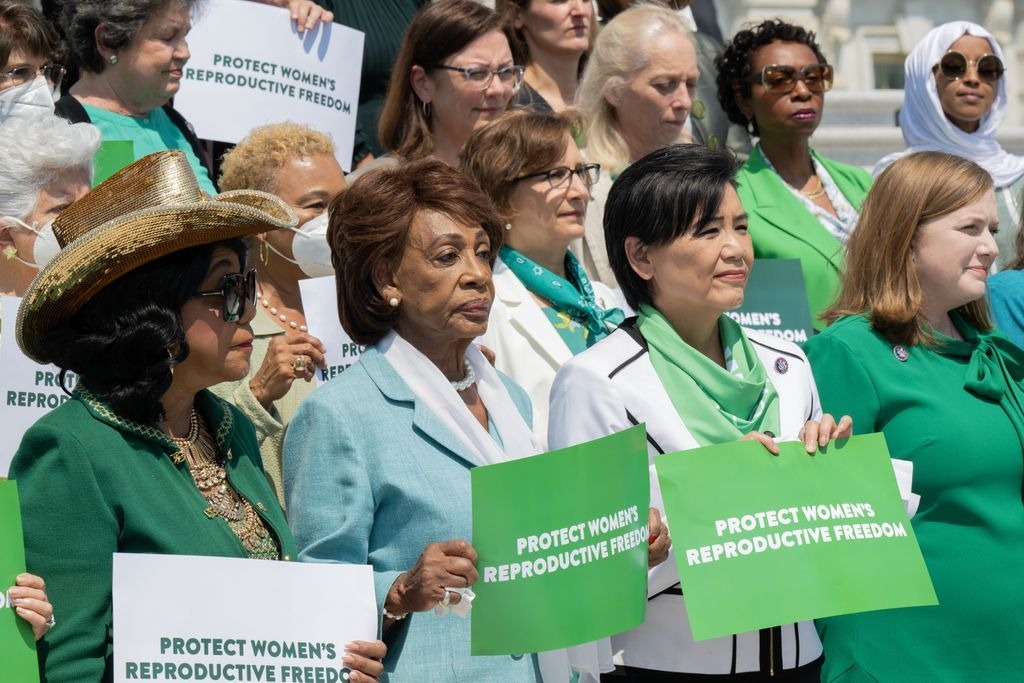
The Democratic Women’s Caucus is fighting so that every woman has access to quality, affordable healthcare and the freedom to make her own reproductive healthcare choices. We’re working to strengthen Medicaid and Medicare, expand access to healthcare, and lower the cost of prescription drugs. We are committed to ensuring that reproductive healthcare services, including contraception, abortion, and maternal care, are accessible to every woman no matter what state they live in without barriers or stigma. Women should not face life-threatening risks during childbirth, and Black mothers and babies should thrive with equitable, compassionate care. We are fighting for that future, and one where women’s health research is prioritized and well-funded, leading to breakthroughs that save lives. Every woman and family deserve quality healthcare so they stay healthy, and live with dignity, security, and choice.

Better Future Legislative Slate: Women’s Health

Advancing and strengthening women’s healthcare is one of the key pillars in the Democratic Women’s Caucus Better Future Agenda. As Trump and Republicans roll back reproductive rights across the country and slash funding for women’s health research, the DWC has a bold vision and is charting a different path forward. We demand a future that protects and expands reproductive healthcare; lowers the cost of prescription drugs and healthcare coverage; addresses the maternal mortality crisis; invests in mental health and substance use treatment; provides healthcare for immigrant women and girls; confronts racial and gender disparities in healthcare outcomes; and defends Medicaid, Medicare, and the Affordable Care Act. Below is a slate of bills led by DWC members that we are pushing forward to fulfill our commitment to building a healthier, more equitable future for all.

Restores & Expands Reproductive Healthcare

Abortion

    • This bill, introduced by DWC Reproductive Healthcare Task Force Co-Chair & Liaison Judy Chu (CA-28), would protect a person’s ability to determine whether to continue or end a pregnancy, and to protect a healthcare provider’s ability to provide abortion services.
    • This bill, led by DWC Vice Chair Emilia Sykes (OH-13) and DWC member Suzanne Bonamici (OR-01), would direct the Federal Trade Commission (FTC) to prohibit false advertising of abortion services and give the FTC the authority to enforce the regulations and penalize organizations in violation.
    • This bill, introduced by DWC member Becca Balint (VT-at-Large), would repeal provisions of the Comstock laws in the U.S. Code that anti-abortion extremists want to willfully misapply in order to ban abortion nationwide without any congressional action.
    • This bill, introduced by DWC Chair Emerita Lois Frankel (FL-22), would permanently repeal the Global Gag Rule to ensure women across the world continue to have access to information about abortion and reproductive health.
    • This bill, led by DWC Reproductive Healthcare Task Force Co-Chair & Liaison Ayanna Pressley (MA-07), would ensure those enrolled in government health insurance plans and their dependents have coverage for abortion care; ensure those who are enrolled in a government-managed health insurance program due to an employment relationship have coverage for abortion care; and ensure those who receive their healthcare from a government provider or program have access to abortion care through these providers and programs.
    • This bill, introduced by DWC Communications Task Force Co-Chair Jasmine Crockett (TX-30), would increase access to medically accurate information about abortion, medication abortion, and abortion-related health services.
    • This bill, introduced by DWC member Julia Brownley (CA-26), would explicitly protect veterans’ rights to receive abortion services, counseling, and medication from the U.S. Department of Veterans Affairs (VA).
    • This bill, introduced by DWC Servicewomen, Women Veterans, & Military Families Task Force Chair Chrissy Houlahan (PA-05), DWC Member Services Task Force Co-Chair Sara Jacobs (CA-51), and DWC member Marilyn Strickland (WA-10), would amend the current U.S. Code to allow the Department of Defense (DoD) to use available funds and facilities to perform abortions.
    • This bill, led by DWC Chief Whip Nikema Williams (GA-05), would increase access to reproductive and sexual healthcare services, including abortion, by creating an Ombuds for Reproductive and Sexual Health in the Department of Health and Human Services (HHS). The Ombuds would increase awareness of abortion resources across the country and monitor the spread of healthcare misinformation.
    • This bill, led by DWC Policy Task Force Co-Chair Deborah Ross (NC-02), would protect Americans’ ability to access safe, effective medications (like mifepristone) that have been reviewed and authorized by the Food and Drug Administration (FDA) by clarifying that FDA approval of medicines preempts state efforts to ban their prescription, provision, or use.
    • This bill, led by DWC Equality Caucus Liaison Julie Johnson (TX-32), would require the State Department to include in its annual reports:
      • Any government efforts to expand or restrict access to contraception, abortion, maternal healthcare, and HIV services
      • Rates and causes of pregnancy-related deaths, including those from unsafe abortion
      • Discrimination, coercion, or violence in reproductive health settings — including against women, LGBTQI+ people, and people with disabilities
      • Obstetric violence, forced sterilization or pregnancy, and criminalization of pregnancy outcomes
      • Disparities in care based on race, ethnicity, disability, age, sexual orientation, and gender identity.

Birth Control

    • This bill, introduced by DWC Chief Whip Nikema Williams (GA-05), DWC Member Services Task Force Co-Chair Sara Jacobs (CA-51), as well as members Angie Craig (MN-02), and Lizzie Fletcher (TX-07), would guarantee the legal right for individuals to obtain and to use contraception; prohibit the federal government or any state from administering, implementing, or enforcing any law, rule, regulation, standard, or other provision that would prohibit or restrict the sale, provision, or use of contraception; and allow the Department of Justice (DOJ), providers, and individuals harmed by restrictions on contraception access made unlawful under the legislation to go to court to enforce these rights.
    • This bill, introduced by DWC member Julia Brownley (CA-26), would give women veterans access to the same contraceptive care as their non-veteran counterparts, without co-pays.
    • This bill, sponsored by DWC member Robin Kelly (IL-02), would amend the Public Health Service Act to establish certain duties for pharmacies to ensure provision of Food and Drug Administration-approved contraception and medication related to contraception, and for other purposes.

Fertility Care

    • This bill, introduced by DWC member Julia Brownley (CA-26), would include infertility care, including in vitro fertilization (IVF), as part of VA healthcare for enrolled veterans, regardless of marital status, service-connection, or need for donated genetic material.
    • This bill, introduced by DWC member Laura Gillen (NY-04), would prohibit the limitation of access to assisted reproductive technology, like in vitro fertilization (IVF), and all medical care surrounding such technology.
    • This bill, led by DWC member Debbie Wasserman Schultz (FL-25), requires private employer-sponsored health plans that already cover obstetrical care to also cover infertility testing, treatments, and fertility preservation services for women diagnosed with infertility, including iatrogenic fertility.
    • This bill, led by DWC member Rosa DeLauro (CT-03), would require all health insurances to provide coverage for infertility treatment, as well as fertility preservation services for individuals who undergo medically necessary procedures that may cause infertility, such as chemotherapy.

Menstrual Care

    • This bill, introduced by DWC member Grace Meng (NY-06), would expand access to menstrual products through federal programs, in certain locations, and for particular groups.
    • This bill, led by DWC member Yassamin Ansari (AZ-03), would provide 12 days of paid leave for symptoms related to reproductive health conditions and procedures, including but not limited to menstrual pain, menopause, endometriosis, IUD insertion, pregnancy terminations, vasectomies, and fertility treatments.

Lowers Healthcare Costs

    • This bill, introduced by DWC member Rosa DeLauro (CT-03), would ensure all health insurance plans cover screening and diagnostic breast imaging with no cost-sharing.
    • This bill, led by DWC Senate Liaison & Caregiving Task Force Co-Chair Debbie Dingell (MI-06), would make breast cancer diagnostic tests more affordable and accessible to women by eliminating copays and additional out-of-pocket expenses.
    • This bill, led by DWC Senate Liaison & Caregiving Task Force Co-Chair Debbie Dingell (MI-06), would lower prescription drug costs for all Americans and end pharmaceutical price gouging by requiring drug companies to offer medications in the United States at no more than the lowest price per drug in twelve other similarly developed countries.
    • This bill, led by DWC Policy Task Force Co-Chair Deborah Ross (NC-02), would repeal a flawed policy that has increased costs and arbitrarily slashed reimbursement for certain therapy providers since 2013. When patients have treatment for multiple therapy services on the same day after a stroke, only the first service is fully reimbursed by Medicare. Women make up the majority of Medicare beneficiaries and face a disproportionate burden of stroke disability and mortality.

Increases Healthcare Access

    • This bill, led by DWC National Leaders & Advocacy Organizations Liaison Joyce Beatty (OH-03), would reauthorize and expand access to the Centers for Disease Control and Prevention’s (CDC) WISEWOMAN (Well-Integrated Screening and Evaluation for Women Across the Nation) program.
    • This bill, led by DWC member Debbie Wasserman Schultz (FL-25), reauthorizes three breast cancer awareness and prevention programs within the Centers for Disease Control and Prevention.
    • This bill, led by DWC Congressional Hispanic Caucus Liaison Andrea Salinas (OR-06), would expand access to peer-to-peer support services for those struggling with mental health and substance use disorders.
    • This bill, led by DWC Senate Liaison & Caregiving Task Force Co-Chair Debbie Dingell (MI-06), would permanently extend telehealth flexibilities established during the COVID-19 pandemic to make it easier for people to continue to access remote care many have come to depend on.
    • This resolution, led by DWC Policy Task Force Co-Chair Sydney Kamlager-Dove (CA-37), would urge that all pregnant women be tested for Antiphospholipid Syndrome (APS) as a part of the standard prenatal testing to prevent miscarriages and stillbirths.
    • This bill, led by DWC Chief Whip Nikema Williams (GA-05) and DWC member Laura Friedman (CA-30), would repeal the Republicans’ passed budget provision to “defund” Planned Parenthood.
    • This bill, led by DWC member Alma Adams (NC-12), would provide funding for comprehensive, medically accurate, and consent-based sex education. It would also expand access to sexual and reproductive healthcare for adolescents and young adults.
    • This bill, led by DWC Senate Liaison & Caregiving Task Force Co-Chair Debbie Dingell (MI-06), expands the CDC’s National Asthma Control Program to all 50 states. The National Asthma Control Program helps health departments across the country ensure the availability of and access to guidelines-based medical management and pharmacotherapy for all people with asthma to address the public health burden of the disease.
    • This bill, led by DWC member Sylvia R. Garcia (TX-29), would require the Department of Veterans Affairs (VA) to hire or designate a Regional Breast Cancer and Gynecologic Cancer Care Coordinator for each Veteran Integrated Services Network (i.e., regional VA healthcare administrative areas).

Expands Medicaid & Medicare

    • This bill, led by DWC member Debbie Wasserman Schultz (FL-25), would require Medicare to provide coverage of germline mutation testing for individuals with a personal or family history of a hereditary cancer gene mutation or suspected history of hereditary cancer, as well as for associated coverage of risk-reducing surgeries and screenings.
    • This bill, led by DWC Reproductive Healthcare Task Force Co-Chair & Liaison Judy Chu (CA-28), would provide for Medicare coverage of medical nutrition therapy services for individuals with eating disorders.
    • This bill, led by DWC Reproductive Healthcare Task Force Co-Chair & Liaison Judy Chu (CA-28) and DWC member Kathy Castor, would eliminate the waiting periods for Social Security Disability Insurance benefits and Medicare coverage for individuals diagnosed with Metastatic Breast Cancer (MBC).
    • This bill, led by DWC Chief Whip Nikema Williams (GA-05), would provide a 90% federal matching rate for Medicaid maternal healthcare expenditures that exceed 2019 levels. Qualifying services would be provided by maternity care providers or perinatal health workers (e.g., doulas) and include prenatal and postpartum telehealth services, home visits, and behavioral healthcare.
    • This bill, led by DWC Chief Whip Nikema Williams (GA-05), would require health insurance providers—including Medicaid and the Children’s Health Insurance Program (CHIP)—to supply pregnant and postpartum individuals with self-measured blood pressure monitoring devices at no cost.
    • This bill, led by DWC Member Services Task Force Co-Chair Melanie Stansbury (NM-01), would require the Secretary of Health and Human Services to issue guidance on best practices for screening and treatment of congenital syphilis under Medicaid and the Children’s Health Insurance Program (CHIP), and for other purposes.
    • This bill, led by DWC Caregiving Task Force Co-Chair Brittany Pettersen (CO-07), would repeal the budget neutrality requirement for certain Medicaid demonstration projects, including Section 1115 Waivers. Codified as part of H.R. 1, the One Big Beautiful Bill Act, this requirement harms states’ ability to tailor Medicaid programs and offer vital services and treatment options to Medicaid recipients.
    • This bill, led by DWC member Suzanne Bonamici (OR-01), would increase Medicaid payment rates for labor and delivery services for eligible rural and high-need urban hospitals, provide “standby” payments to cover the costs of staffing and maintaining an obstetrics unit at low-volume hospitals, create low-volume payment adjustments for labor and delivery services at hospitals with low birth volumes, and require all states to provide postpartum coverage for women in Medicaid for 12 months.
    • This bill, led by DWC Reproductive Healthcare Task Force Co-Chair & Liaison Judy Chu (CA-28), would expand access to peer support services by requiring Medicare to cover peer support services provided at rural health clinics, federally qualified health centers, community mental health centers, and certified community behavioral health clinics.
    • This bill, led by DWC Senate Liaison & Caregiving Task Force Co-Chair Debbie Dingell (MI-06), would provide 12-months of continuous coverage for all individuals receiving healthcare through Medicaid or the Children’s Health Insurance Program (CHIP) so that they do not risk losing coverage even if their income fluctuates during that time.

Improves Maternal & Child Health

    • This bill, led by DWC member Jennifer McClellan (VA-04), would amend the Public Health Service Act to establish a federal grant program to support mothers and families during pregnancy, childbirth, and the postpartum period by increasing access to short-term childcare.
    • This bill, led by DWC member Marilyn Strickland (WA-10), would increase access to maternity care for servicemembers and their families by extending midwifery care to those enrolled in TRICARE through a 5-year pilot program.
    • This bill, introduced by DWC member Jennifer McClellan (VA-04), would require private health insurance companies to fully cover the costs of childbirth and related maternity care.
    • This bill, led by DWC member Alma Adams (NC-12), would establish a fund specifically and exclusively for community-based organizations working to advance maternal health equity. It would fund programs that implement and study bias, racism, and discrimination training for all employees in maternity care settings. It would establish Respectful Maternity Care Compliance Programs within hospitals for pregnant and postpartum patients to report experiences of discrimination or bias and promote accountability.
    • This bill, led by DWC Vice Chair Emilia Sykes (OH-13), requires infant and toddler food to be tested periodically for contaminants and imposes other safety requirements on food and formula manufacturers. Specifically, the bill would require facilities that manufacture or process infant and toddler food in final form to conduct quarterly tests for contaminants, including lead and arsenic.
    • This bill, led by DWC Vice Chair Emilia Sykes and DWC member Janelle Bynum, would create a grant program to support food farmacies, which offer access to healthy foods and nutritional guidance.
    • This bill, led by DWC member Debbie Wasserman Schultz (FL-25), would establish a 3-year pilot program within the Department of Health and Human Services to provide financial assistance to individuals unable to breastfeed due to a medical condition like cancer so that they can purchase infant formula or donor breast milk.

Supports Mental Health

    • This bill, led by DWC Congressional Hispanic Caucus Liaison Andrea Salinas (OR-06), would bring critical, on-site mental health services to students in public schools across the country and provide $300 million in federal funding for school-based mental health programs to address the nation’s youth mental health crisis.
    • This bill, led by DWC Caregiving Task Force Co-Chair Brittany Pettersen (CO-07), would establish a new Youth Suicide Prevention Demonstration Pilot Program that would support schools, states, Tribes, community partners and youth-serving organizations in implementing, developing and evaluating evidence-based strategies to prevent suicide among children and adolescents.
    • This bill, led by DWC Vice Chair Emilia Sykes (OH-13), reauthorizes Mental and Behavioral Health Education and Training Grants (BHWET). The BHWET Program awards grants to eligible universities and state-licensed mental health nonprofit and for-profit organizations to recruit and train the next generation of behavioral health workers.

Advances Women’s Health Research

    • This bill, led by DWC Reproductive Healthcare Task Force Co-Chair & Liaison Judy Chu (CA-28), would require the Director of the National Cancer Institute to conduct a review of the current state of stomach cancer incidence, prevention, screening, awareness, and future public health importance.
    • This bill, led by DWC Vice Chair Hillary Scholten (MI-03), would direct the National Institutes of Health (NIH) and the U.S. Preventive Services Task Force (USPSTF) to conduct research and testing into the utility of routine baseline hormonal testing of premenopausal women. It would specifically direct the NIH and USPSTF to study the variability of a woman’s hormone levels before she experiences symptoms of perimenopause, as well as any baseline patterns in that variability.
    • This bill, led by DWC member Haley Stevens (MI-11), would authorize funding for thyroid disease research through the Department of Health and Human Services; identify critical gaps in diagnosis and treatment; launch a national public awareness campaign focused on populations most at risk, including women; expand access to evidence-based thyroid care for healthcare providers and health systems; commission a national study on disparities in thyroid disease prevalence, detection, treatment, and outcomes.
    • This bill, led by DWC Chief Whip Nikema Williams (GA-05), would deliver $50 million annually to advance endometriosis research and expand access to treatment.
    • This legislation, led by Communications Task Force Co-Chair Shontel Brown (OH-11), would award grants for research, investigation, and awareness of the effect of personal care products containing endocrine-disrupting chemicals on female reproductive systems.
    • This bill, led by DWC member Yassamin Ansari (AZ-03), would direct the Secretary of Health and Human Services to more precisely identify the barriers to pain management options during and after gynecologic procedures, including IUD insertion, endometrial biopsies, and cancer screenings.
    • This bill, led by DWC member Lori Trahan (MA-03), would establish for the first time a coordinated federal initiative to address headache disorders. More than 40 million Americans are living with migraine and headache disorders, which are the leading cause of disability in the world and for women under 50 years old in the United States.
    • This bill, led by DWC Equality Caucus Liaison Julie Johnson (TX-32), would aim to improve diagnosis, care, and research equity for women and girls with bleeding disorders. This bill would mandate that the Secretary of Health and Human Services conduct an interagency review of barriers to access and propose recommendations; make reports publicly available for transparency and accountability; and conduct a public education and awareness campaign for women and girls with bleeding disorders.

Strengthens the Healthcare System

    • This bill, introduced by DWC members Robin Kelly (IL-02) and Kim Schrier (WA-08), would support rural healthcare facilities providing critical obstetric care by creating a training program for labor & delivery units, new federal grants for rural healthcare facilities to purchase necessary equipment, a pilot program for teleconsultation, and a study on maternity ward closures.
    • This bill, led by DWC Equality Caucus Liaison Julie Johnson (TX-32), would incentivize innovative approaches to address the healthcare workforce shortage by streamlining apprenticeships and offering a pathway to good-paying jobs. Specifically, this bill would amend the National Apprenticeship Act to streamline and update federal and state labor agencies’ healthcare apprenticeship application process by:
      • Requiring federal and state labor agencies to make determinations on healthcare apprenticeship applications within 45 days of receipt.
      • Requiring that the Department of Labor digitize apprenticeship agreement forms, modernize the application process, and enhance accessibility for applicants.
    • This bill, led by DWC Congressional Hispanic Caucus Liaison Andrea Salinas (OR-06), would authorize rural health facilities to use federal USDA funds to refinance debt, update technology, and support operating expenses to ensure their long-term financial stability.
    • This bill, led by DWC member Mary Gay Scanlon (PA-05), would prohibit private equity firms from owning hospitals and skilled nursing facilities. This bill would respond to a growing crisis driven by private equity’s takeover of healthcare providers across the country—a model that has produced higher prices, worse care, mass layoffs, and a record wave of healthcare bankruptcies, stripping communities of the hospitals they depend on.

Combats Discrimination & Criminalization

    • This bill, introduced by DWC member Veronica Escobar (TX-16), would amend the Public Health Service Act to establish a grant program for healthcare providers to enhance the physical and cyber security of their facilities, personnel, and patients.
    • This bill, sponsored by DWC member Lori Trahan (MA-03), would establish clear, nationwide standards to protect patients during sensitive medical examinations and procedures.
    • This bill, led by DWC member Julia Brownley (CA-26), would require the Government Accountability Office (GAO) to study and report on the medical services furnished by the Department of Veterans Affairs (VA) for veterans experiencing perimenopause, genitourinary syndrome of menopause, and menopause stages. The bill would also require the VA to report to Congress on a strategic plan to (1) implement any recommendations GAO makes in its report, (2) improve the quality of menopause care, and (3) improve the access of veterans to menopause care.
    • This bill, led by DWC Communications Task Force Co-Chair Shontel Brown (OH-11), Reproductive Healthcare Task Force Co-Chair & Liaison Ayanna Pressley (MA-07), and member Nydia Velázquez (NY-07), would designate hair straightening or hair smoothing products containing formaldehyde, a known carcinogen, as adulterated under the Federal Food, Drug, and Cosmetic Act, prohibiting their sale or distribution in the United States.
    • This bill, introduced by Member Services Task Force Co-Chair Sara Jacobs (CA-51), would create a new national standard to protect personal reproductive health data.
    • This bill, sponsored by DWC Reproductive Healthcare Task Force Co-Chair & Liaison Ayanna Pressley (MA-07), would amend the Public Health Service Act to provide for public health research and investment into understanding and eliminating structural racism and police violence.
    • This bill, sponsored by Policy Task Force Co-Chair Sydney Kamlager-Dove (CA-37), would prohibit the Centers for Medicare and Medicaid Services and the Department of Health and Human Services from disclosing Medicaid data to be used for immigration enforcement. Immigrant mothers should not have to fear the possibility of deportation to access essential Medicaid services for their U.S. citizen children.
    • This bill, led by DWC Congressional Asian Pacific American Caucus Liaison Pramila Jayapal (WA-07), would eliminate restrictions on access to public assistance, such as Medicaid and the healthcare exchange, for immigrant survivors who are lawfully present, including clarifying that immigrants eligible for U visas, Special Immigrant Juvenile Status, and self-petition.
    • This bill, led by DWC Congressional Asian Pacific American Caucus Liaison Pramila Jayapal (WA-07), would remove barriers to healthcare for immigrants of all statuses, helping immigrant women of all statuses access healthcare, including reproductive healthcare.
    • This bill, led by DWC member Sylvia Garcia (TX-29), would protect the health and safety of pregnant women in immigration detention by reinstituting their presumption of release, prohibiting the U.S. Department of Homeland Security (DHS) from shackling pregnant women in its custody, and setting new standards of care and transparency for the treatment of pregnant women and youth.
    • This bill, led by DWC Chief Whip Nikema Williams (GA-05), would establish a new grant program, administered by the HHS Office of Minority Health, to expand access to culturally and linguistically appropriate care, encourage innovation, and address persistent health disparities and chronic disease challenges. Grants would help cover the cost of providing preventative care—including free or low-cost health screenings, vaccinations, family planning services, and mental health services.

DWC Letters in the 119th Congress

Below is a list of letters sent by the Democratic Women’s Caucus to fight for women’s health by expanding healthcare access, protecting reproductive rights, improving maternal health outcomes, and combating healthcare discrimination. Through these actions, DWC consistently pushes back against efforts to cut Medicaid, restrict reproductive care, and undermine the health and well-being of women and families.

    • Urges the VA to withdraw a rule to reinstate a near-total ban on abortion care and abortion counseling.